

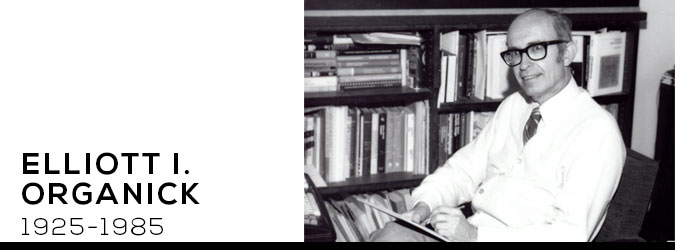
Background
Elliott I. Organick served fifteen years at the University of Utah, tirelessly helping shape the Department’s academic and research programs. In addition, he brought recognition and honor to the Department through his prolific writing, his unstinting professional service, and the warmth of his humanity.
Upon his passing in 1985 many of his friends, colleagues and former students established a permanent memorial, the Elliott I. Organick Endowment. This endowment enhances the Computer Science environment in Utah through a pair of lectures which are the highlight public events of each academic year.

2026 Lecture - Jeffrey P. Bigham, Carnegie Mellon University
October 20, 2026
Warnock Engineering Building - RM 1250 ; University of Utah
72 S Campus Center Drive, SLC, Utah 84112
4:30 PM: Reception - Catmull Gallery
5:30 PM: Lecture - 1250 WEB
Accessibility Predicts Interaction in the AI Realization Era
Transit and Parking Information:
Warnock Engineering Building - Room 1250
72 S Campus Center Drive, SLC, Utah 84112
PUBLIC TRANSIT: Ride UTA Trip Planner
Click the linked image below for a map or click here for Google Maps location.
Past Lectures
(36) 2025 – Vinod Vaikuntanathan, MIT
(35) 2024 – Alexis “Alyosha” Efros, UC Berkeley (VIDEO)
(34) 2023 – Elizabeth Churchill, Senior Director of UX at Google
(33) 2021 – Telle Whitney, Co-founder Grace Hopper Celebration
(32) 2019 – Pat Hanrahan, Stanford University
(31) 2018 – Maurice Herlihy, Brown University
(30) 2017 – Kathy Yelick, UC Berkeley
(29) 2016 – Moshe Vardi, Rice University
(28) 2015 – Farnam Jahanian, Carnegie Mellon University
(27) 2014 – Ed Lazowska, University of Washington
(26) 2013 – Peter Neumann, SRI International
(25) 2012 – David E. Shaw, D.E. Shaw Research
(24) 2010 – Sebastian Thrun, Stanford University
(23) 2009 – Ed Catmull, Ph.D., President Walt Disney and Pixar Animation Studios
(22) 2008 – Fran Allen, IBM T.J. Watson Research Laboratory
(21) 2007 – Jeannette Wing, Carnegie Mellon University
(20) 2006 – Alan Kay, Viewpoints Research Institute, Inc.
(19) 2005 – Vinton Cerf, Technology Strategy, MCI Inc.
(18) 2004 – Jim Gray, Microsoft Research
(17) 2003 – David Patterson, UC Berkeley
(16) 2002 – David Gelernter, Yale University
(15) 2001 – Bill Joy, Sun Microsystems, Inc.
(14) 2000 – Takeo Kanade, Carnegie Mellon University
(13) 1999 – Guy L. Steele, Jr., Sun Microsystems, Inc.
(12) 1998 – Richard M. Karp, University of Washington
(11) 1997 – Raj Reddy, Carnegie Mellon University
(10) 1996 – John Hennessy, Stanford University
(9) 1995 – Robert E. Kahn, Corporation for National Research Initiatives
(8) 1994 – Butler W. Lampson, Digital Equipment Corporation
(7) 1993 – Ivan Sutherland, Sun Microsystems, Inc.
(6) 1992 – Dana S. Scott, Carnegie Mellon University
(5) 1991 – Carver A. Mead, California Institute of Technology
(4) 1990 – Donald E. Knuth, Stanford University
(3) 1989 – C.A.R. Hoare, Oxford University
(2) 1988 – John E. Hopcroft, Cornell University
(1) 1987 – Kristen Nygaard, University of Oslo, Norway
For more information on the series please contact ellen.marie.lewis@utah.edu